










When we start building a DIY battery pack, deciding the right nickel strip size may be challenging. Neight too thick or too thin a nickel strip will affect the working condition of the whole battery pack. So it is very important to make sure the nickel strips are suitable enough.
1. Understanding Nickel Strip Specifications
Nickel strips used in battery packs typically come in different thicknesses and widths.
1- Nickel Strip Thickness:
The thickness of the nickel strip affects its conductivity and mechanical strength. Common thicknesses range from 0.1 mm to 0.5 mm. Thicker strips can handle higher currents and provide better durability, while thinner strips are more flexible and easier to work with but may not support high currents as effectively.
2- Nickel Strip Width:
The width of the nickel strip affects its ability to conduct electricity and distribute heat. Widths can vary from 5 mm to 15 mm. A wider strip can handle more current and reduce resistance, but it may also be more challenging to handle and fit into tight spaces.
2. Determine Your Battery Pack Requirements
To choose the right size of nickel strip, you need to consider the following factors:
1- Current Load:
The amount of current your battery pack will deliver is a crucial factor in determining the appropriate nickel strip size. Higher currents require thicker and wider strips to prevent excessive heat buildup and voltage drop. For instance, if your battery pack is designed for high-drain applications such as power tools or electric vehicles, thicker and wider nickel strips are needed to carry higher current
2- Battery Cell Size and Configuration:
The size of the battery cells and their configuration (series or parallel) will also influence the choice of nickel strip size. For instance, if you are working with large-format cells or high-capacity packs, you might need wider and thicker strips to ensure proper connections and support.
Heat Dissipation: Nickel strips help in heat dissipation during high-current operation. If your battery pack will generate a lot of heat, ensure that the nickel strips you choose have sufficient thickness and width to handle the heat without degrading.
3. Calculate the Required Nickel Strip Size
To make an informed decision, calculate the required nickel strip size based on the expected current load and battery configuration. Here’s a simplified approach:
Determine the Maximum Current:
Calculate the maximum current your battery pack will handle. This can be estimated based on the battery cells’ specifications and the desired discharge rate to your motors.
Based on the battery configuration(series or parallel), you need to calculate the current that goes through every part of the nickel strip, especially when you need to pay more attention to the current that goes through the nickel strips that connect the neighboring series of battery cells.
Consult Current Rating Tables:
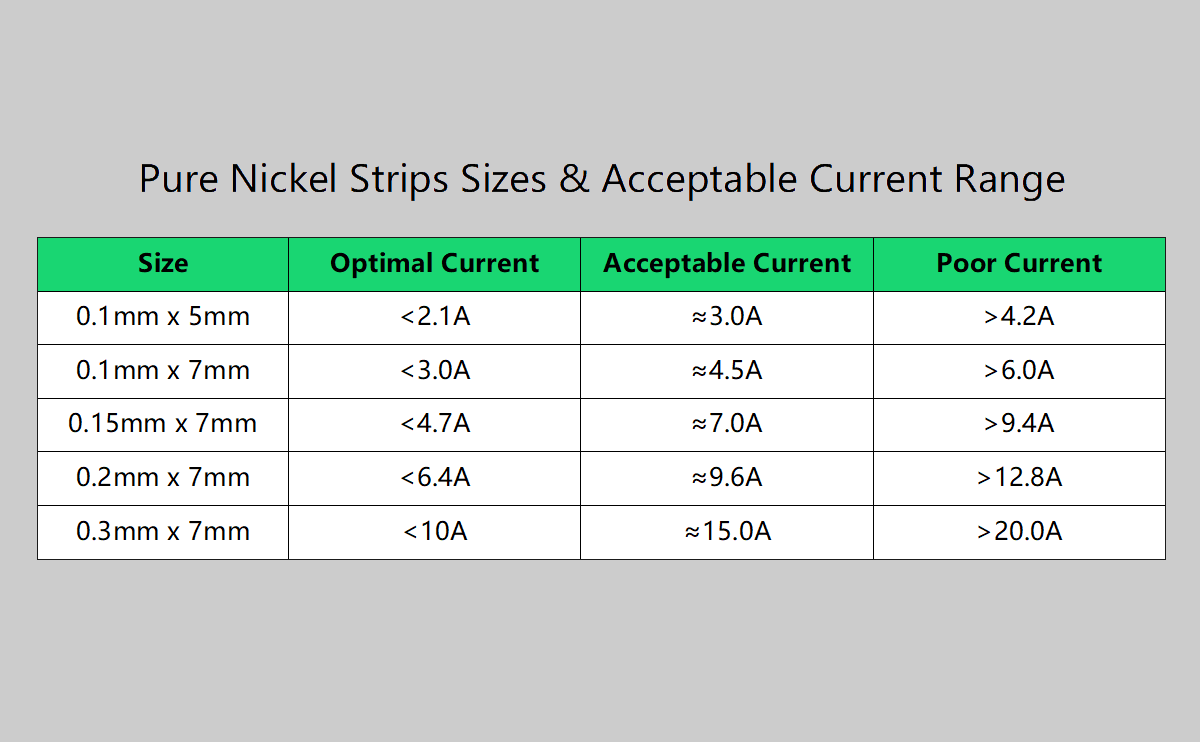
Look at current rating tables or charts provided by nickel strip manufacturers. These tables show the maximum current ratings for different thicknesses and widths of nickel strips. Choose a strip that comfortably handles your battery pack’s maximum current without excessive heat buildup. Below is a chart for reference:

Here is an example:
Assume there is a battery Pack 2S4P(see attached picture), and the maximum current for the battery pack is 12A. Then we can know the current that needs to be carried by is 12A/4=3A, refer to the chart, we know 0.1mm x 5mm nickel strip is acceptable, and 0.1mm x 7mm is a better choice.
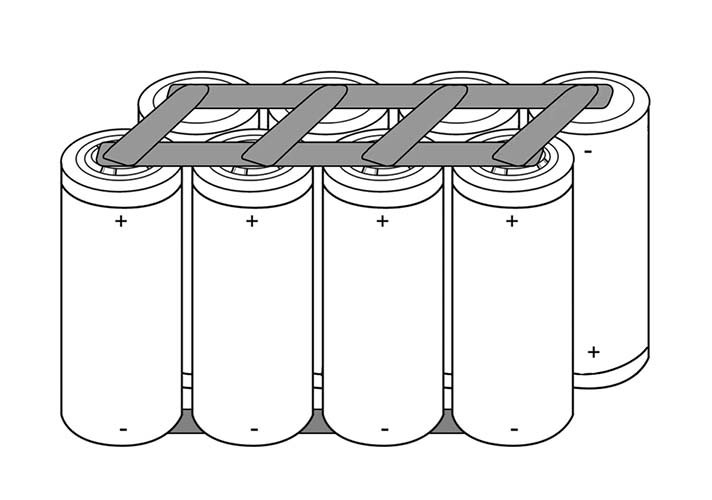
However, due to different battery pack designs, people will have different connection methods for the battery pack. We still take this battery pack 2S4P as an example(see picture below).

In this case, the current for the nickel strip (between 2 series of the battery cells) will be higher, 12A/2=6A, refer to the chart, we need to make the nickel strip size at least 0.15mm x 7mm, or stack 2pcs of 0.1mm x 5mm nickel strips to double the current rating.
Conclusion
Choosing the right pure nickel strip size for DIY battery packs involves a careful balance of technical specifications, practical considerations, and safety. By understanding the importance of thickness and width, calculating your requirements, and considering practical aspects, you can select the most suitable nickel strips for your project. Welcome to contact us or discuss with us if you have and idea or question.